

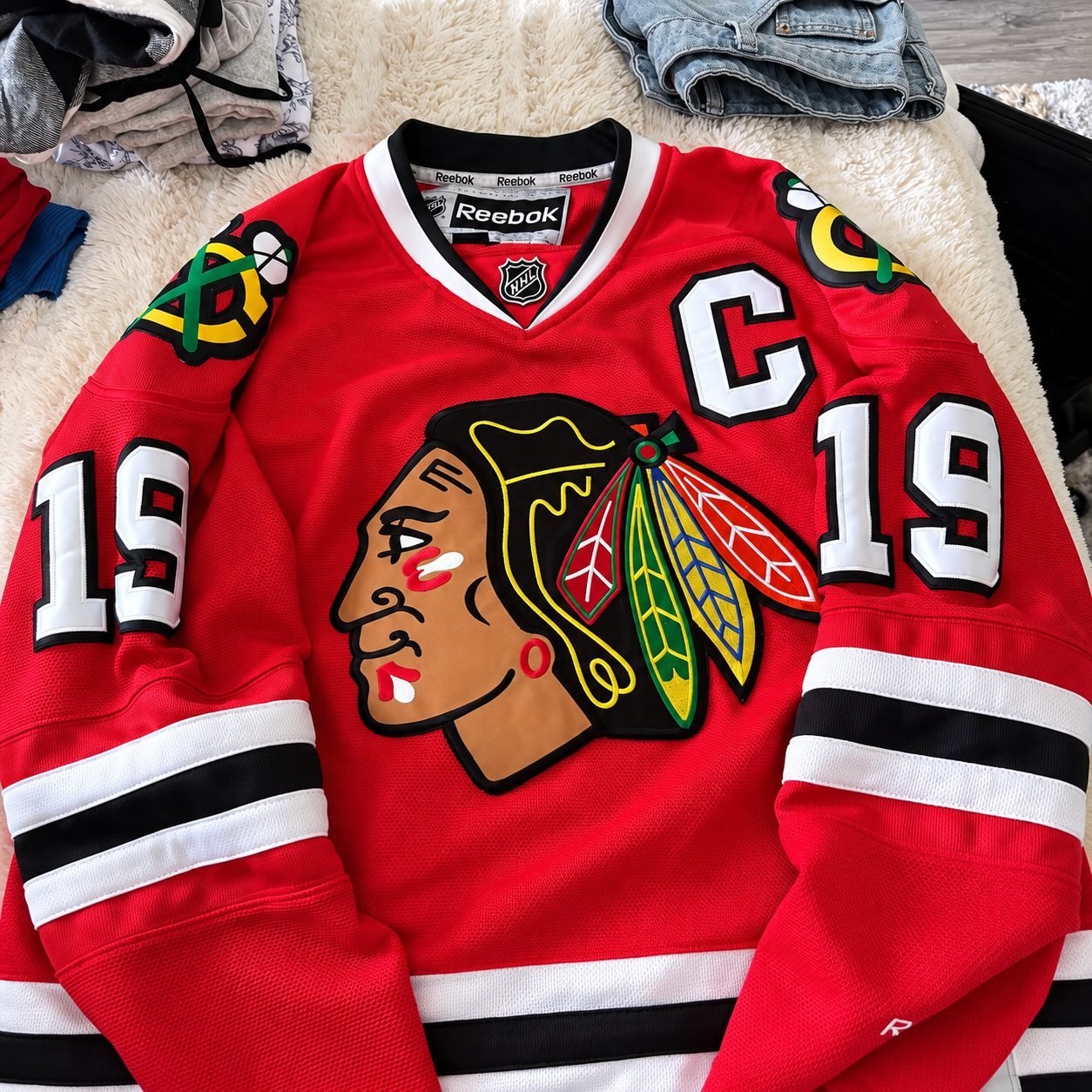
The “C” marks the team captain, and the “A” marks an alternate captain, not an assistant captain like most people guess. Both letters exist for one official reason: only the player wearing one of them can discuss a rule interpretation with the referee during a game.
This guide breaks down exactly what each letter means, how many a team can dress at once, and the one position that’s never allowed to wear either.
In this guide
- What the “C” means
- What the “A” means
- How many letters a team can dress
- What wearing the letter allows you to do
- Why goalies can never wear the “C” or the “A”
- Where the letter sits on the jersey
- Why some teams go a whole season without naming one
- How this compares to other sports
- Where FANKIT fits into this
- FAQ
- Where to go from here
What the “C” means
The captain leads the team, represents the players in disputes with officials, and usually handles media duties after games. Coaches or management typically choose the captain, though some organizations let the players vote on it themselves.
Beyond talking to referees, the NHL rulebook gives the captain no other formal powers. Everything else, the locker room leadership, the pregame speeches, the example-setting, happens informally. No co-captains exist in the NHL. A team picks exactly one person to wear the “C,” full stop.

What the “A” means
Here’s the part that trips almost everyone up: “A” stands for alternate captain, not assistant captain. You’ll hear “assistant” constantly from broadcasters and casual fans, but it’s never been the official term.
An alternate steps into the captain’s on-ice role the moment the captain leaves the ice, whether that’s a shift change, an injury, or a trip to the penalty box. Whoever’s wearing the “A” at that moment picks up the same referee-communication privilege the captain would otherwise hold. Some teams spread their captain and alternates across different lines on purpose, so there’s almost always a letter on the ice no matter who’s out there.


How many letters a team can dress
The NHL rulebook sets a specific limit, and it depends on whether the team has a captain at all.
| Situation | Captains | Alternate captains |
|---|---|---|
| Team has a captain | 1 | Up to 2 |
| Captain not in uniform | 0 | Up to 3 |
Scope note: a coach can only bump the alternate count up to three when the captain isn’t dressed for that specific game, not as a standing choice. The moment the captain suits up again, the team drops back to two alternates.
A team with more than two players splitting alternate duty across a season rotates who wears the “A” game to game, since only two can hold the letter at once with a captain in uniform.
What wearing the letter allows you to do
This is the rule the letters exist for in the first place: only the captain, or an alternate when the captain is off the ice, can approach an official to ask about a rule interpretation. Everyone else on the roster stays out of that conversation entirely.
Step onto the ice to argue a call without the letter, and you’re not just overstepping a tradition. The NHL’s Rule 39 covers abuse of officials directly, and a player who leaves the bench to protest a call draws a minor penalty for unsportsmanlike conduct on the first offense. Keep pushing it, and that escalates to a misconduct, then a game misconduct.
It’s worth being precise about what counts here too. A general complaint about a call isn’t the same as a question about how a rule was applied, and only the second one falls under the captain’s actual privilege.
Why goalies can never wear the “C” or the “A”
The NHL rulebook states it plainly: no goaltender, and no playing coach or playing manager, can serve as captain or alternate captain. The practical reason is simple. A goalie would have to leave the crease to relay a referee’s ruling back to the bench, and that’s not something the league wants happening mid-game.
This wasn’t always the rule. Goalies captained NHL teams in the league’s early decades, going back to John Ross Roach captaining the Toronto St. Patricks in 1923. Charlie Gardiner wore the “C” for the Chicago Blackhawks in 1934, and that team’s Stanley Cup win that same year remains the only championship won by a team with a goalie wearing the captain’s letter.
The ban arrived after the 1947-48 season, following an incident involving Montreal goaltender Bill Durnan, who left his crease to argue calls with referees often enough that it became a running problem. Hockey history still refers to the current rule informally as the Durnan Rule. A handful of teams have since given a goalie an honorary captaincy, Roberto Luongo with the Vancouver Canucks in 2008 among them, but the actual on-ice referee duties always fall to an alternate in those cases.
Where the letter sits on the jersey
NHL rules require the letter in a conspicuous spot on the front of the sweater, without locking teams into one exact position. Tradition puts it on the upper left chest, which is why that’s where you’ll see it on most jerseys.
A handful of teams whose crest already occupies the left side move the letter to the right instead, since both spots satisfy the conspicuous-placement requirement. The Florida Panthers have gone further since the 2016-17 season, adding a separate “Captain” or “Alternate” patch above the left sleeve in addition to the standard letter.
Why some teams go a whole season without naming one
Naming a captain isn’t required at all. A team can leave the role empty for an entire season, sometimes longer, and let its alternates split the leadership duties between them instead.
This happens most often right after a long-time captain retires or gets traded, when a team would rather wait a season and watch who steps up naturally than hand the “C” to someone too soon. Three alternates rotating the “A” cover the referee-communication rule just as well as a single captain would, so nothing about the on-ice rulebook forces a team’s hand.
Age and tenure matter more to how fast a team names one than any formal rule does. Connor McDavid became the youngest full-time captain in NHL history when the Edmonton Oilers gave him the “C” at 19 years and 266 days old in October 2016, breaking a record held by Gabriel Landeskog with the Colorado Avalanche by just a few weeks. Most captains wait considerably longer, often several full seasons with one organization, before a team hands them the letter permanently.
How this compares to other sports
Hockey’s sewn-on letter is one of the more unusual ways a sport marks its team leader. Soccer uses an armband instead of anything stitched onto the shirt itself, which the captain swaps between teammates mid-match if a substitution calls for it. Basketball generally skips a visible marker altogether, leaning on verbal communication with officials instead of anything worn on the jersey.
That contrast says something real about hockey specifically: the letter isn’t a badge of honor so much as a functional marker the referees need to see instantly, in a sport where stopping play to figure out who’s allowed to talk to them would slow the game down constantly.
Where FANKIT fits into this
FANKIT doesn’t make hockey jerseys, so a custom “C” or “A” letter in the hockey style isn’t something you’ll find in its lineup. Its custom order process covers soccer, basketball, rugby and training wear, and kids’ team sets instead.
If your rec league soccer team wants to mark a captain on a custom jersey, soccer’s own tradition points you toward an armband rather than a sewn letter, though design touches like a different trim color or placement for your team captain are worth asking about directly. Reach out to FANKIT with what you have in mind, and describe the sport and the look you’re going for rather than assuming hockey’s letter system carries over.
FAQ
Does “A” on a hockey jersey stand for assistant captain?
No. It stands for alternate captain, even though “assistant” is the far more common guess and gets used constantly in casual conversation.
How many alternate captains can an NHL team have?
Up to two, if the team has a captain in uniform. If the captain isn’t dressed for that game, the coach can designate up to three alternates instead.
Can a goalie be a team captain in the NHL?
No, under the current rule. Goaltenders, along with playing coaches and playing managers, are barred from wearing either the “C” or the “A.”
What is the captain allowed to do that other players can’t?
Discuss rule interpretations with the referee. That’s the letter’s entire formal purpose. Everything else associated with being a captain is informal leadership, not a rulebook power.
Why did the NHL ban goalie captains?
The rule followed the 1947-48 season, after Montreal goaltender Bill Durnan repeatedly left his crease to argue calls with officials. It’s still known informally as the Durnan Rule.
Does FANKIT make hockey jerseys with captain letters?
No. FANKIT’s custom lineup covers soccer, basketball, rugby and training wear, and kids’ team sets. Hockey isn’t part of that catalog.
Where to go from here
The letters look simple, but they exist for one specific job: telling the referee exactly who’s allowed to question a call. If a custom soccer, basketball, rugby, or kids’ team jersey is what brought you here, FANKIT’s build-your-own process above covers marking out a team leader in whatever way fits that sport.
Need a custom captain’s jersey for a non-hockey sport?
FANKIT builds custom soccer, basketball, rugby, and kids’ team jerseys. Mark your team leader with an armband, a contrast trim, or a different placement rather than a sewn letter — reach out with the sport and the look you have in mind and we’ll point you to the right option.